Author: Jojo

  • Why Do Clothes Still Smell After Washing?

    Why Do Clothes Still Smell After Washing?

    There’s nothing more frustrating than washing a load of clothes only to realize they still don’t smell completely clean.

    Sometimes the odor is noticeable as soon as the cycle ends. Other times, the clothes seem perfectly fine when they are dry but start smelling again once you wear them.

    If that keeps happening, the problem isn’t always that your detergent is too weak.

    Sweat, body oils, damp laundry, an overloaded machine and even the washing machine itself can all make odors harder to remove. The type of fabric can matter too, especially with workout clothes and other synthetic materials.

    Here’s where I would look first.

    1. The Odor May Still Be Trapped in the Fabric

    Clothes collect much more than visible dirt throughout the day.

    Sweat, skin oils and other residue can build up in areas that sit close to the body, especially around underarms, collars and waistbands.

    If those substances aren’t removed effectively during washing, some odor can remain in the fabric.

    This tends to be especially noticeable with clothes such as:

    • workout tops
    • sports bras
    • synthetic T-shirts
    • leggings
    • socks

    Polyester and other synthetic fabrics can also behave differently from cotton when it comes to odor. Research into textile odor has found that fiber type can affect how odor-related compounds and bacteria interact with clothing.

    That doesn’t mean synthetic clothing is dirty or that you should avoid it. Performance fabrics have plenty of useful qualities, including being lightweight and quick-drying.

    It simply helps explain why a heavily worn synthetic gym top may hold onto odor differently from an everyday cotton T-shirt.

    For clothes that have been worn close to the body, turning them inside out before washing can also help expose the areas that have had the most contact with sweat and skin.

    2. Sweaty Clothes Are Sitting Damp for Too Long

    Sometimes the problem starts hours before the washing machine is turned on.

    A sweaty gym shirt rolled up inside a bag or buried at the bottom of a laundry basket stays warm and damp with very little airflow.

    The longer it sits that way, the more stubborn the odor can become.

    If you aren’t washing sweaty clothes straight away, try letting them air out first.

    The same goes for:

    • swimwear
    • damp socks
    • wet exercise clothes
    • anything that is noticeably moist after use

    You don’t need a complicated system.

    The goal is simply to avoid leaving damp fabric crumpled in a pile for long periods.

    3. The Washing Machine Is Too Full

    It’s tempting to fit as much as possible into one load, especially when the laundry basket is overflowing.

    But clothes need room to move during the wash.

    When the drum is packed too tightly, water and detergent may not circulate through the load as effectively, making it harder to remove sweat, oils and everyday soil.

    This can become particularly noticeable with heavily worn clothes.

    If a full load of gym clothes, socks and everyday laundry regularly comes out less fresh than expected, try washing a slightly smaller load before changing detergents or adding another laundry product.

    Sometimes the machine simply needs more room to do its job.

    4. The Wash Cycle May Not Match the Laundry

    A quick cycle can be useful for lightly worn clothes.

    It may not always be enough for clothing that is sweaty, heavily worn or noticeably soiled.

    The right cycle depends on:

    • the fabric
    • how dirty the clothes are
    • the garment care instructions
    • the detergent you are using

    Instead of automatically choosing the same setting for every load, consider whether the clothes actually need a longer or more thorough wash.

    Water temperature can matter too, but hotter isn’t automatically better.

    Always check the care label first and use a temperature that is appropriate for the fabric.

    The aim is not to wash everything as hot as possible. It is to choose a wash that is suitable for both the garment and the level of soil.

    5. Clean Clothes Are Staying Wet After the Cycle

    Even a properly washed load can start smelling unpleasant if it stays wet in the machine for too long.

    Most of us have forgotten a load of washing at least once.

    A few hours later, you open the door and that fresh-laundry smell has been replaced by something noticeably mustier.

    If possible, remove clothes reasonably soon after the cycle finishes.

    The same principle applies after they come out of the washer.

    Make sure clothes are completely dry before:

    • folding them
    • putting them into drawers
    • storing them in a wardrobe
    • piling them together

    If something still feels slightly damp, give it more time.

    Putting clothes away before they are fully dry can undo a lot of the work you just did in the wash.

    6. The Washing Machine Itself May Need Cleaning

    If different types of laundry all seem to come out with the same stale smell, the clothes may not be the main problem.

    Washing machines can collect detergent residue, lint, dirt and moisture in places that stay damp between loads.

    Depending on the machine, areas worth checking may include:

    • the rubber door seal
    • detergent dispenser
    • drum
    • filter
    • other cleaning points listed in the manufacturer’s instructions

    Front-loading machines can be particularly prone to moisture sitting around the rubber gasket.

    If the washing machine itself smells when you open the door, that is a useful clue.

    Clean the machine according to the manufacturer’s instructions rather than using a random household cleaning mixture.

    Allowing the machine to air out between washes, where practical and safe, can also help prevent moisture from sitting inside for long periods.

    What Should You Do With Clothes That Already Smell?

    If freshly washed clothes still smell, I wouldn’t start by covering the odor with more fragrance.

    Instead, think about where the problem seems to be happening.

    If it is mainly workout clothes, check the fabric, turn them inside out and make sure the washer isn’t overloaded.

    If the whole load smells musty, think about whether the clothes sat wet after the cycle.

    If the same odor appears in almost every load, inspect the washing machine.

    And if you tend to use a generous amount of detergent, check the recommended dose before adding more.

    Using extra detergent doesn’t necessarily mean cleaner clothes. I’ve covered that in more detail in my guide to how much laundry detergent to use.

    The goal is to identify the most likely cause rather than changing five things at once.

    If Only Certain Clothes Keep Smelling

    Pay attention to the fabric.

    A polyester workout top or synthetic uniform may behave differently from the cotton clothes in the same household.

    Research into textile odor has found that fiber type can influence how odor compounds are retained and released, with measurable differences between polyester and cotton.
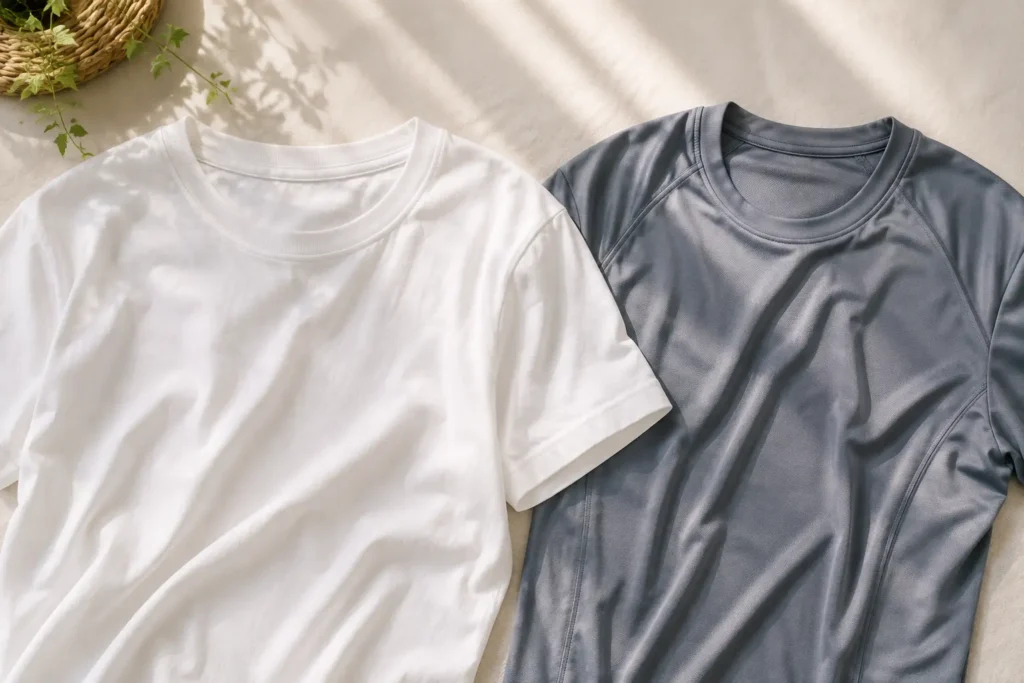
    Cotton T-shirt and synthetic activewear laid side by side for laundry comparison

    That means a washing routine that works perfectly well for everyday cotton clothing may not give exactly the same result with heavily worn synthetic sportswear.

    Again, this isn’t a reason to avoid performance clothing.

    Synthetic activewear is popular for good reasons. It can be lightweight, stretchy and quick-drying.

    It simply means that a garment’s fabric, how heavily it was worn and how it was handled before washing can all affect the result.

    Before reaching for more detergent, check the care label and think about:

    • how long the garment sat before washing
    • whether it was still damp
    • how heavily it was worn
    • whether it had enough room in the washer
    • whether the wash cycle suited the fabric

    Those details can often tell you more than the strength of the laundry fragrance.

    Final Thoughts

    If clothes still smell after washing, there usually isn’t one single explanation.

    The odor may be coming from sweat and body oils remaining in the fabric, damp clothes sitting too long, an overloaded washer, a wash cycle that doesn’t suit the load or a washing machine that needs cleaning.

    Start with the most likely cause rather than changing everything at once.

    Let sweaty clothes air out if you can’t wash them straight away. Give the load enough room. Choose a cycle that suits the fabric and soil level. Remove clean laundry reasonably soon after washing and let it dry completely.

    And if the same stale smell keeps appearing across very different loads, take a closer look at the washing machine itself.

    A few simple adjustments are often more useful than adding another laundry product.

    Sources & Further Reading

    American Cleaning Institute — Laundering Problems & Solutions
    Practical guidance on poor soil removal, washer overloading and wash temperature.

    Whirlpool — How to Remove Tough, Stinky Odors From Clothes
    Guidance on lingering clothing odors, sweaty or damp laundry and everyday washing habits.

    McQueen et al. — Textile Sorption and Release of Odorous Volatile Organic Compounds From a Synthetic Sweat Solution
    Research examining how odor-related compounds interact with different textile fibers.

    Callewaert et al. — Microbial Odor Profile of Polyester and Cotton Clothes After a Fitness Session
    Research comparing odor development in polyester and cotton clothing after exercise.


  • Powder vs Liquid Laundry Detergent: Which Is Better?

    Powder vs Liquid Laundry Detergent: Which Is Better?

    Powder or liquid laundry detergent: does one actually clean better than the other?

    For most everyday laundry, both can work well when used correctly. The better choice usually comes down to the kind of washing you do, the stains you deal with and which format is more convenient for your routine.

    Rather than looking for one overall winner, it helps to understand where each type has an advantage.

    What’s the Difference Between Powder and Liquid Detergent?

    The main difference is simply the form they come in.

    Powder detergent contains dry ingredients that dissolve once they mix with water.

    Liquid detergent is already in liquid form, so it can disperse into the wash water straight away.

    Both are available in different formulas and concentrations, which means performance can vary just as much between brands as it does between powder and liquid.

    That’s why the format alone doesn’t tell you whether a detergent is better.

    When Liquid Detergent Makes Sense

    Liquid detergent is particularly convenient if you often deal with greasy or oily stains.

    Because it is already liquid, many products can be applied directly to a stain before washing, as long as the detergent instructions and garment care label allow it.

    That can be useful for stains such as:

    • cooking oil
    • makeup
    • greasy food marks
    • collar and cuff soil

    Liquid detergent is also convenient for people who frequently wash in cool water because there are no powder granules that need to dissolve first.

    That doesn’t mean liquid detergent always performs better in cold water. Modern detergents vary widely by formula. It simply removes one potential issue: undissolved powder.

    When Powder Detergent Makes Sense

    Powder detergent can be a good option for everyday loads and clothing with ground-in dirt.

    It can be particularly useful for things like:

    • muddy clothes
    • dusty workwear
    • children’s outdoor clothing

    Powder can also be mixed with a little water to make a paste for pretreating certain stains, provided the product instructions allow it.

    There are practical advantages too. It is easy to store, there is no liquid to leak, and some people simply prefer measuring from a box rather than pouring from a bottle.

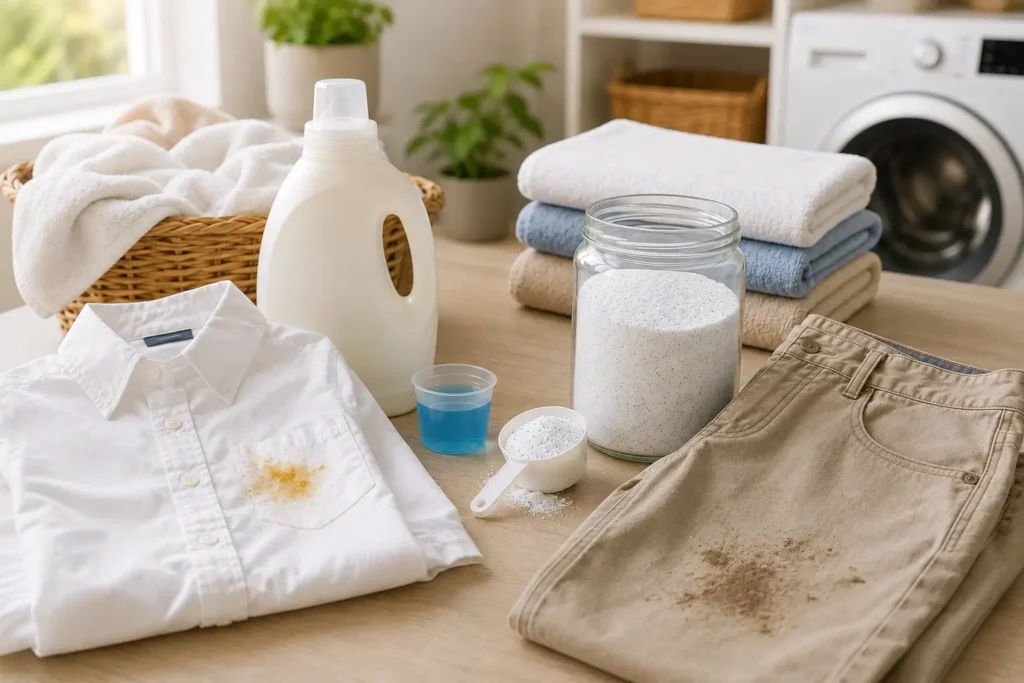
    Liquid detergent beside a lightly stained shirt and powder detergent beside muddy trousers in a laundry room

    What About Cold-Water Washing?

    This is one of the more noticeable practical differences between the two formats.

    Powder needs enough water and time to dissolve properly.

    If you regularly use very cold water or short wash cycles, check whether your detergent is designed for those conditions.

    Powder residue on clothing can sometimes be linked to poor dissolving or rinsing, particularly when the machine is overloaded or too much product is used.

    Liquid detergent avoids the issue of granules needing to dissolve, but liquid can still leave residue when used incorrectly.

    So if you prefer powder, cold-water washing doesn’t automatically mean you need to switch. Just make sure the product suits the way you wash.

    Does One Clean Better?

    Not necessarily.

    There are situations where one format may be more convenient, but there is no simple rule that one format always cleans better than the other.

    Liquid is handy for pretreating oily stains.

    Powder is often a practical choice for ground-in dirt.

    For an ordinary load of everyday clothing, either can work well.

    The detergent formula, the amount you use, the wash cycle and the type of soil on the clothing can all affect the result.

    If your current detergent consistently gets your clothes clean, there may be little reason to change simply because another format sounds better.

    LiquidPowder
    Greasy stainsOften well suitedCan be used
    Ground-in dirtGoodOften useful
    Cold waterConvenientCheck dissolving
    StorageCan leakEasy to store
    PretreatingVery convenientCan make paste

    Which One Is Cheaper?

    There isn’t a universal winner here either.

    Prices vary by brand, concentration, pack size and where you live.

    Instead of comparing the price of the bottle or box, look at the cost per wash.

    Check:

    • how many washes the package claims to provide
    • the recommended amount per load
    • whether the detergent is concentrated
    • the actual price per wash

    A large bottle is not necessarily better value if you need a larger dose each time.

    Likewise, a smaller concentrated detergent may last much longer than its package size suggests.

    What About Packaging?

    Powder and liquid also come with different packaging considerations.

    Powder is often sold in cardboard boxes or lightweight bags, while liquid usually comes in bottles or refill pouches.

    It can be tempting to say that one format is automatically the more environmentally friendly choice, but the full picture is more complicated.

    Packaging material, detergent concentration, transportation, ingredients and how much product you use all matter.

    If reducing packaging is important to you, compare the actual products available where you live rather than relying on the detergent format alone.

    So Which Should You Choose?

    Choose based on the laundry you actually do.

    Liquid detergent may suit you if:

    • you regularly pretreat greasy or oily stains
    • you wash mostly in cool water
    • you prefer a product that is already dissolved
    • you find pouring liquid more convenient

    Powder detergent may suit you if:

    • you often wash muddy or dusty clothing
    • you prefer a dry product
    • you want something easy to store without leaks
    • your usual wash cycles dissolve powder well

    You also don’t have to commit to only one.

    If there’s a practical reason for it, you can keep one detergent for most loads and another for particular stains or types of laundry.

    Final Thoughts

    There isn’t one best detergent format for every household.

    Liquid detergent is convenient for greasy stains, pretreating and cool-water washing. Powder can be a practical choice for everyday laundry and ground-in dirt.

    If the detergent you already use cleans your clothes well and works with your routine, you don’t need to switch simply because another format is marketed as better.

    Choose the one that makes sense for the laundry you actually do.

    Sources & Further Reading

    American Cleaning Institute — Laundry Basics
    General guidance on detergent formats, dosing and laundry use.

    American Cleaning Institute — Stain Removal Guide
    Information on using liquid detergent or a powdered detergent paste to pretreat different types of stains.

    Maytag — White Residue on Clothing
    Information about factors that can contribute to visible detergent residue, including excess detergent and very cold wash water.

  • Do You Really Need Fabric Softener?

    Do You Really Need Fabric Softener?

    Fabric softener is one of those laundry products that can easily become part of the routine without us ever stopping to ask what it actually does.

    Detergent goes in. Fabric softener goes in. Then the wash starts.

    But do you really need fabric softener every time?

    Not necessarily.

    Fabric softener can make certain fabrics feel smoother, reduce static and add fragrance, but it doesn’t do the cleaning. And for some things we wash regularly, that softer finish may come with a trade-off.

    The easiest way to think about it is not “Is fabric softener good or bad?” but:

    What am I washing, and what do I need that fabric to do?

    That one question makes the decision much simpler.

    What Does Fabric Softener Actually Do?

    Detergent and fabric softener have different jobs.

    Detergent is there to help remove dirt, oils and other residue during the wash.

    Fabric softener is generally added during the rinse stage. Many liquid fabric softeners contain conditioning ingredients that settle onto the surface of fabric fibers and reduce friction between them. That is part of what gives clothes a smoother, softer feel.

    Depending on the product, fabric softener may also help:

    • reduce static
    • add fragrance
    • make some fabrics feel smoother after drying
    • reduce the rough feeling certain clothes can develop over time

    Those can all be useful benefits.

    But there is one distinction worth remembering:

    Soft laundry and clean laundry are not the same thing.

    Detergent does the cleaning. Fabric softener changes the finish.

    Once I understood that difference, it became much easier to decide when I actually wanted to use it.

    1. Towels Don’t Always Benefit From Fabric Softener

    Towels are a good example of why softer isn’t automatically better.

    We want them to feel comfortable, but their main job is to absorb water.

    Some common fabric-softening ingredients can make the surface of fibers more water-repellent, which may reduce how easily treated fabrics take up water again. Textile references describe this as reduced rewetting performance.

    That doesn’t mean using fabric softener once will suddenly ruin your towels.

    But if you use it regularly and your towels have started feeling less absorbent or strangely coated, it may be worth leaving it out for a few washes and seeing what changes.

    I would pay attention to how the towels actually perform rather than whether they feel extra soft when they come out of the laundry.

    Do they absorb water well?

    Do they still feel fresh when damp?

    Do they seem heavy or coated?

    If your towels also develop a musty smell after washing, I covered several possible causes in Why Do Towels Smell After Washing?.

    2. Check Before Using It on Sportswear

    This is one area where reading the care label really matters.

    Many modern sports fabrics are designed to move moisture away from your skin. Some manufacturers specifically advise against using fabric softener on moisture-wicking garments because residue on the fibers can interfere with the way the fabric manages moisture. Nike, for example, gives this advice for its Dri-FIT and other synthetic performance clothing.

    That can include things like:

    • running tops
    • sports bras
    • leggings
    • gym shirts
    • other moisture-wicking clothing

    You don’t need to memorize which fabrics are safe and which aren’t.

    If something is designed to wick sweat, repel water or perform another technical function, check the garment’s care label first.

    That is more reliable than applying one laundry rule to everything you own.

    3. Microfiber Cleaning Cloths Are Better Kept Simple

    I would also skip fabric softener when washing microfiber cleaning cloths.

    Microfiber cleaning products rely on very fine fibers to pick up dust, moisture and grime. Fabric softener can leave residue on those fibers, which may make the cloth less effective at doing the job it was designed for.

    This is one of those cases where a simpler wash routine makes more sense.

    Wash the cloth for what it needs to do rather than trying to make it feel softer.

    The same general principle applies to a lot of laundry:

    Don’t improve one quality of a fabric at the expense of the reason you bought it.

    4. Special Fabrics Deserve a Quick Look at the Label

    Rather than keeping a long mental list of fabrics that should or shouldn’t get softener, I find this rule much easier:

    If the item has a special function, check the care label.

    That includes clothing designed to:

    • wick moisture
    • repel water
    • provide insulation
    • stretch in a particular way
    • meet a specific performance standard

    Care labels are easy to ignore when we are doing a normal load of laundry, but they are often the best source of information for that particular garment.

    So When Does Fabric Softener Make Sense?

    There are still plenty of reasons someone might choose to use it.

    Maybe:

    • your clothes feel noticeably rough after air drying
    • static is a recurring problem
    • you enjoy the fragrance
    • you prefer how certain everyday fabrics feel with it

    There is nothing wrong with using a product because you like the result.

    The important part is recognizing that it is optional, not a required step in every load.

    For ordinary clothes where absorbency or technical performance isn’t important, using fabric softener according to the product directions may be perfectly reasonable.

    Do You Need It in Every Wash?

    Probably not.

    This is the biggest change I made in how I think about fabric softener.

    I used to treat it as part of the washing process itself.

    Now I think of it as a finishing product.

    That makes the decision much easier.

    For example:

    Towels: usually skip it.
    Microfiber cloths: skip it.
    Sportswear: check the care label.
    Everyday clothes: use it if you like the result.

    That feels much more practical than using the same combination of laundry products for every load.

    What Happens If You Stop Using Fabric Softener?

    Your clothes will still be washed.

    The biggest difference may simply be how some fabrics feel after drying.

    You might notice:

    • slightly more static
    • clothes feeling a little firmer after air drying
    • less fragrance
    • towels feeling different or more absorbent

    The result depends on the fabric, how you dry your clothes and the way you normally do laundry.

    You also don’t need to make it a permanent experiment.

    If you have used fabric softener for years, try leaving it out for a few loads and see what you actually notice.

    That tells you much more about whether you need it than following a blanket rule online.

    What If You Mainly Use It for the Fragrance?

    For a lot of people, this is probably the real reason.

    Fresh laundry smells nice. I understand the appeal.

    But I’ve started separating fragrance from cleanliness in my own laundry routine.

    A strong scent can make clothes feel freshly washed, but it doesn’t tell me whether they rinsed properly, dried properly or still perform the way they should.

    That doesn’t mean fragrance is bad.

    It just means I no longer use scent as the test for whether laundry is clean.

    Sometimes I want that extra fragrance.

    Sometimes I don’t.

    You Can Also Just Use It Less Often

    Fabric softener doesn’t have to be an all-or-nothing decision.

    If you like it, you can simply be more selective.

    For example:

    • use it for regular clothing when you want a softer finish
    • leave it out of towel loads
    • skip it for microfiber cloths
    • follow the care label for sportswear and technical garments

    That is probably the most realistic approach for many households.

    You keep the part of the product you enjoy without automatically adding it to every wash.

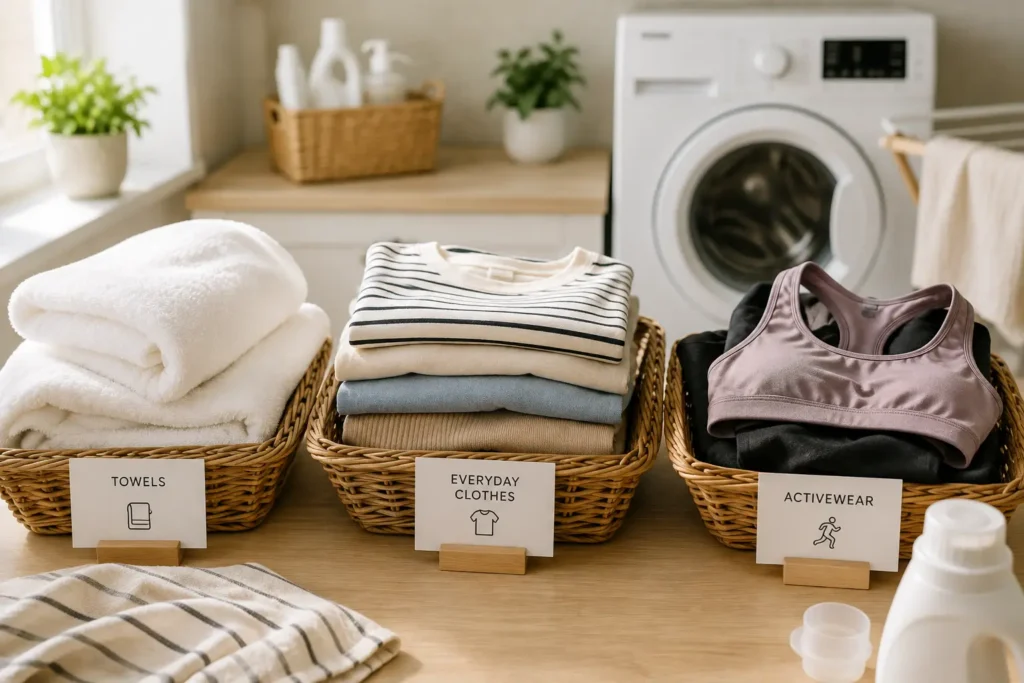
    Towels, everyday clothes and activewear sorted into separate laundry baskets

    Final Thoughts

    You don’t need fabric softener to get your laundry clean.

    Its main role is to change the way fabric feels, reduce static and, in many products, add fragrance.

    For everyday clothing, using it may simply come down to preference.

    For towels, microfiber cloths and some technical sports fabrics, skipping it can make more sense.

    Instead of automatically adding it to every wash, look at what is actually in the machine and what you need those fabrics to do afterward.

    Sometimes fabric softener is useful.

    Sometimes it is unnecessary.

    Knowing the difference is more helpful than following the same laundry routine every time.

    Sources & Further Reading

    1. Li, Y. et al. — Water hardness effect on the association and adsorption of cationic cellulose derivative/anionic surfactant mixtures for fabric softener application. Colloids and Surfaces A, 2021. Explains how fabric-softening ingredients adsorb onto fibers and reduce friction. ScienceDirect study
    2. Schindler, W. D. & Hauser, P. J. — Chemical Finishing of Textiles: Softening Finishes. Discusses how common softeners affect fiber surfaces, softness and rewetting properties. ScienceDirect overview
    3. Nike — Care guidance for sports and moisture-wicking clothing. Advises avoiding fabric softener on certain synthetic performance fabrics because it can interfere with their intended moisture-management properties. Nike sportswear care guide
    4. Rubbermaid Commercial Products — Microfiber care guidance. Recommends avoiding fabric softener when laundering microfiber because it can reduce cleaning performance. Rubbermaid microfiber care information

  • Why Do Towels Smell After Washing?

    Why Do Towels Smell After Washing?

    You take a towel out of the washing machine expecting it to smell clean, but something still feels off.

    Sometimes the musty smell is noticeable straight away. Other times, the towel seems perfectly fine when it is dry, only for the smell to come back the moment it gets wet again.

    If this keeps happening, washing the towels again with more detergent probably isn’t the answer.

    Towels are thick and highly absorbent, which is exactly what makes them useful. But those same qualities also make it easier for moisture, detergent residue and body oils to stay trapped in the fibers.

    Here are some of the most common reasons towels smell after washing and a few simple changes that can help.

    1. You May Be Using Too Much Detergent

    It’s easy to assume that a little extra detergent will make towels cleaner.

    But more detergent doesn’t always mean a better wash.

    If you use more than your washing machine can rinse away properly, some of it can remain in the towel fibers. Over time, that residue can build up and hold onto body oils, moisture and other laundry products.

    You may notice that your towels feel heavier or slightly stiffer than they used to. They may not absorb water as well, or they may smell fine when dry but develop an odor once they get damp.

    If you tend to fill the detergent cap without measuring carefully, try cutting back and following the recommended amount for your load and machine.

    Not sure how much detergent to use? See my guide on how much laundry detergent to use for a simple starting point.

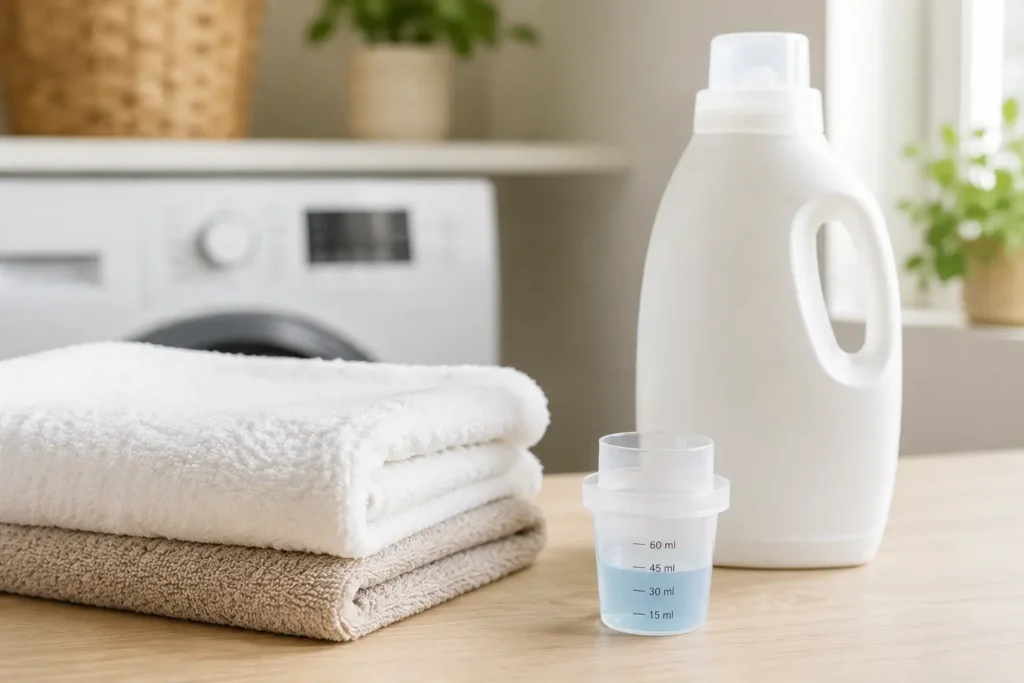
    Measuring liquid laundry detergent before washing towels

    2. Damp Towels Are Sitting Around Too Long

    Sometimes the problem starts before the towels even reach the washing machine.

    A wet bath towel tossed straight into a laundry basket can stay damp for hours, especially when it is buried underneath clothes or other towels.

    The same thing can happen after washing. Towels that sit in the washing machine for too long, get piled together while damp, or are folded before they are completely dry can quickly lose that fresh feeling.

    Because towels are so absorbent, they often take longer to dry than lighter clothes.

    If you’re not washing a used towel straight away, try hanging it up and letting it dry before putting it in the laundry basket.

    After washing, take towels out of the machine as soon as you reasonably can and make sure they are completely dry before putting them away.

    It’s a very small change, but it can make a noticeable difference.

    3. The Washing Machine Is Too Full

    I’m definitely guilty of trying to squeeze “just one more thing” into the washing machine.

    With towels, though, an overloaded drum can make it harder for them to wash and rinse properly.

    Towels become heavy once they absorb water, and they need enough room to move around during the cycle. If everything is packed tightly together, water may not move through the load as effectively and detergent may be harder to rinse away.

    Dirt and body oils may also be harder to remove, and the towels can sometimes come out wetter than usual.

    You don’t need to wash only a couple of towels at a time. Just avoid packing the drum so tightly that everything is pressed together.

    Giving the load a little more space may work better than adding more detergent.

    4. Fabric Softener Can Build Up on Towels

    Fabric softener sounds like something towels should love.

    Soft towels are the goal, after all.

    But regular fabric softener use can sometimes work against what you actually want from a towel.

    Many fabric softeners leave a coating on the fibers to create that softer feel. Over time, that coating can affect absorbency and add to the buildup already sitting in the fabric.

    If your towels feel unusually heavy, slippery or less absorbent than they used to, try washing them without fabric softener for a while.

    You may find that they perform better without it.

    If you use fabric softener on towels regularly, try leaving it out for a few washes and see whether you notice a difference in how the towels feel and absorb water.

    5. The Smell Might Actually Be Coming From Your Washing Machine

    If towels aren’t the only things coming out of the wash smelling stale, it’s worth checking the washing machine itself.

    Washing machines deal with detergent, lint, dirt and moisture every day, and residue can collect in places we don’t normally see.

    Check the rubber seal around the door, the detergent drawer, the drum and the filter if your machine has an accessible one. Always follow the cleaning instructions for your particular machine.

    Front-loading machines can also stay damp around the door seal after a wash. Allowing the inside of the machine to dry between loads, where practical and safe, can help prevent moisture from sitting there for long periods.

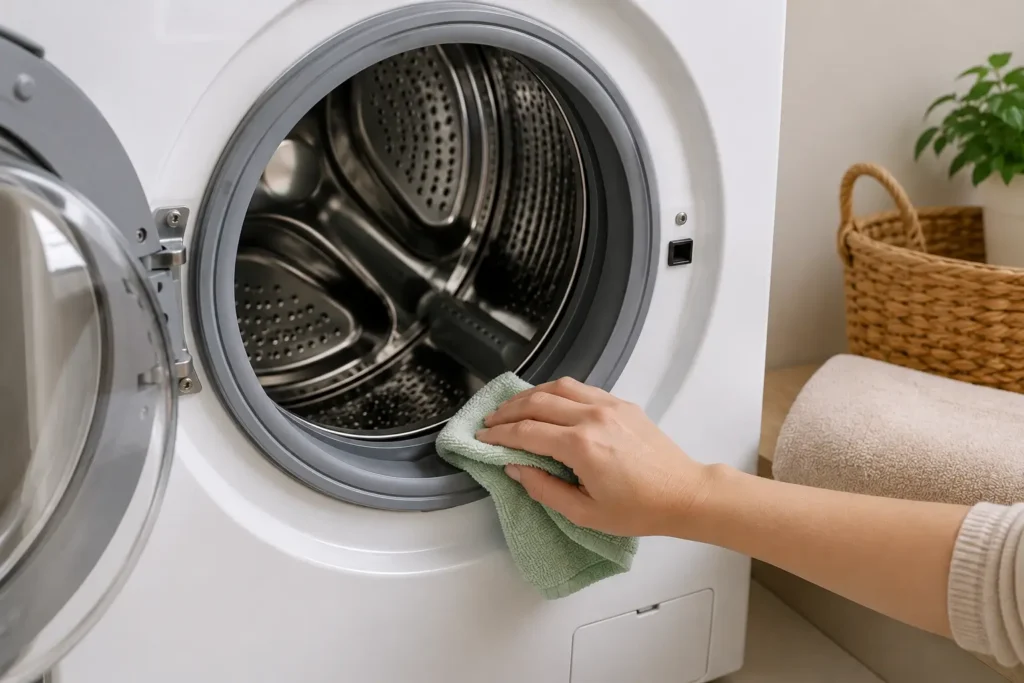
    Cleaning the rubber door seal of a front-loading washing machine

    Why Do Towels Smell Fine Until They Get Wet Again?

    This is probably the part that confuses people most.

    You take a freshly washed towel out of the cupboard and it smells completely normal.

    Then you use it after a shower and suddenly that old smell is back.

    When this happens, it can be a sign that residue or odor wasn’t completely removed from the fibers during washing. Once the towel absorbs water again, the smell becomes much easier to notice.

    This is also why adding more fragrance isn’t necessarily a solution.

    A strongly scented detergent or fabric softener might make a dry towel smell fresh, but fragrance doesn’t tell you whether detergent residue, body oils or moisture are still trapped in the fabric.

    What Should You Do With Towels That Already Smell?

    You probably don’t need to throw them away or completely overhaul your laundry routine.

    Start with the simplest changes.

    Try using a little less detergent if you have been generous with it. Give the towels more room in the washing machine so they can move and rinse properly. Skip fabric softener for a few washes, particularly if the towels feel coated or less absorbent.

    Most importantly, make sure they dry completely before folding or storing them.

    If other laundry also comes out smelling stale, check and clean the washing machine according to the manufacturer’s instructions.

    If buildup has developed over a long period, you may not notice a huge difference after just one wash. Give it a few laundry cycles and pay attention to how the towels feel and smell.

    One Small Habit That Helps at Our House

    One of the easiest things I’ve changed is what happens to wet towels before laundry day.

    I try not to put a damp towel straight into the laundry basket.

    If it isn’t being washed that day, I hang it up first and let it dry.

    It sounds almost too simple to matter, but a wet towel sitting in a pile with very little airflow is much more likely to develop that musty smell in the first place.

    Sometimes the easiest way to fix a laundry problem is to stop it from developing before the wash even starts.

    Clean Doesn’t Have to Mean Strongly Scented

    I used to think laundry smelled cleaner when the fragrance was stronger.

    Now I pay much more attention to how the fabric actually feels and behaves.

    Does the towel rinse properly? Does it absorb water well? Does it dry completely? Does it still smell fresh once it gets damp?

    Those things tell me more than a strong laundry scent does.

    And in many cases, simplifying the routine works better than adding another product.

    A sensible amount of detergent, enough room in the washing machine and proper drying can solve a surprising number of towel problems.

    Final Thoughts

    If your towels smell after washing, the cause is often something quite ordinary.

    Too much detergent, damp towels sitting around, an overloaded machine, fabric softener buildup or a washing machine that needs cleaning can all contribute.

    Start with one or two simple changes rather than trying everything at once.

    Use a little less detergent. Give towels room to move in the wash. Let them dry completely.

    Then see what changes over the next few laundry days.

    Sometimes better laundry really is that simple.

  • How Much Laundry Detergent Should You Actually Use?

    How Much Laundry Detergent Should You Actually Use?

    If you’ve ever poured laundry detergent into the cap, looked at the washing machine, and thought, That looks about right, you’re probably not alone.

    Laundry is one of those everyday jobs many of us learn simply by watching someone else do it. We know where the detergent goes. We know which button starts the machine.

    But how much detergent are we actually supposed to use?

    The answer is less straightforward than one universal measurement:

    There isn’t one correct amount for every load.

    The right amount depends on the detergent you use, the size of your load, how dirty the clothes are, and the type of washing machine you have.

    And one of the most useful things I’ve learned is this:

    More detergent does not automatically mean cleaner laundry.

    Quick Answer: How Much Laundry Detergent Should You Use?

    Start with the dosage instructions on your detergent bottle or package.

    Then adjust according to:

    load size → soil level → washing machine

    Different detergents have different concentrations, so there isn’t one tablespoon or cap measurement that works for every product.

    For an average load of lightly worn clothes, avoid automatically using the maximum recommended amount. Measure the detergent rather than simply pouring until it looks right.

    Why More Laundry Detergent Isn’t Always Better

    It’s easy to assume that adding a little extra detergent will help clothes come out cleaner.

    But whatever goes into the washing machine also needs to be rinsed back out.

    Using more detergent than your laundry needs can contribute to excess suds, poor rinsing, detergent residue on clothing, and buildup inside the washer.

    You might notice:

    • white or chalky residue on clothes
    • clothes that feel stiff or coated after washing
    • excessive suds during the wash
    • a slippery or soapy feeling inside the washer
    • buildup around the detergent dispenser or drum
    • laundry that regularly needs an extra rinse
    • musty odors developing in the washing machine

    That can feel counterintuitive.

    You can use more detergent and end up with laundry that feels less clean.

    So, How Do You Know How Much Detergent You Need?

    The best starting point is always the instructions for your particular detergent.

    Laundry detergents are not all the same strength. Some are highly concentrated, so a relatively small amount may be enough for a normal load.

    That’s why advice such as “always use one tablespoon” or “fill the cap halfway” doesn’t necessarily work for everyone.

    Instead, consider these three things.

    1. How Much Laundry Are You Washing?

    A small load generally needs less detergent than a large one.

    But a large load doesn’t mean packing your washing machine as tightly as possible.

    Clothes still need enough room to move so water and detergent can circulate properly and rinse away afterward.

    Start with the manufacturer’s recommendation for your load size rather than automatically filling the detergent cap.

    2. How Dirty Are the Clothes?

    A load of lightly worn everyday clothing is very different from muddy sportswear, greasy work clothes, or heavily stained kids’ clothes.

    Heavily soiled laundry may need a higher recommended dose.

    Lightly worn clothing may need less.

    The important part is not treating every load exactly the same.

    If most of your laundry is simply everyday clothing that has been worn once, there may be no reason to use the maximum recommended amount every time.

    3. What Type of Washing Machine Do You Have?

    The type of washing machine you use can also make a difference.

    If you have a high-efficiency (HE) washer, including many modern front-loading machines, use a detergent designed for low-water washing systems.

    These machines generally use less water than traditional washers, so they also need detergent that produces fewer suds and rinses away efficiently.

    Using too much detergent can create more foam than the machine can rinse properly, potentially leaving residue on clothes or inside the washer.

    This is also why the recommended amount can sometimes look surprisingly small.

    Rather than copying someone else’s measurement, check both your washing machine instructions and the dosage guide on your detergent.

    Different machines and detergents are designed to work differently, so the right amount for one household may not be right for another.

    A Simple Test I Use at Home

    One of the easiest ways I check for detergent buildup at home is surprisingly simple:

    I run a wash or rinse cycle without adding any detergent.

    I started doing this because I wanted to know whether I had been using more detergent than my laundry actually needed.

    If noticeable suds still appear even though I haven’t added any new detergent, I take that as a clue that detergent residue may still be sitting in the clothes, the washing machine, or both from previous loads.

    It doesn’t necessarily prove that every previous load contained too much detergent. Suds or residue can have other causes.

    But it can be a useful sign that detergent may not be rinsing away as completely as you think.

    When I see suds during a detergent-free cycle, I usually run another rinse and reduce the amount of detergent I use in future loads.

    It’s a very simple check, but doing it made me much more aware of how easy it is to use more detergent than necessary.

    How to Stop Guessing Every Time You Do Laundry

    You don’t need to calculate a perfect measurement for every single load.

    A simple routine is enough.

    First, check the recommended dosage on your detergent.

    Then think about:

    How much laundry is there?
    How dirty is it?
    What type of washing machine am I using?

    If it’s an average load of lightly worn clothes, start with an appropriate lower-to-middle amount within the product’s recommended range rather than automatically using the maximum.

    And measure it.

    If you tend to pour detergent straight from the bottle, you may be surprised by how inconsistent the amount can be from one load to another.

    After the wash, pay attention to the result.

    Your clothes should feel clean without feeling coated or soapy. You shouldn’t regularly need additional rinses just to make your laundry feel properly rinsed.

    If everything already comes out clean, adding more detergent probably won’t improve the result.

    What If You’ve Been Using Too Much Detergent?

    There’s no need to completely change your laundry routine.

    Just start measuring more carefully from your next load.

    If clothes feel soapy or coated, an additional rinse may help remove some of the remaining detergent.

    If you notice visible buildup inside your washer or the machine has developed an odor, check the manufacturer’s instructions for cleaning the washing machine and use the recommended cleaning cycle.

    Then reduce the amount of detergent you use and see how your laundry responds.

    You may find that your clothes still come out perfectly clean with less detergent than you were using before.

    Laundry Detergent Caps Can Be Misleading

    One reason it’s so easy to overuse detergent is the packaging itself.

    Large detergent bottles often come with fairly large measuring caps.

    When the recommended dose only fills a small portion of the cap, it can look like it couldn’t possibly be enough.

    So we add a little more.

    And maybe another splash just to be safe.

    But how full the cap looks has nothing to do with how concentrated the detergent is.

    If the manufacturer says a particular line is enough for a normal load, pouring well beyond that line may simply give your washing machine more detergent to rinse away.

    If the cap is difficult to read or measure accurately, try using a small measuring cup or spoon instead.

    It may feel slightly fussy at first, but once you know what your normal amount looks like, it becomes much easier.

    What About Laundry Pods?

    Laundry pods remove some of the guesswork because the detergent is already pre-measured.

    But the same basic principle still applies:

    More pods do not automatically mean cleaner clothes.

    The appropriate number depends on the particular product, the size of the load, and how dirty the laundry is.

    Check the package instructions before automatically adding a second or third pod.

    And always store laundry pods and other detergent products safely out of reach of children.

    The Laundry Rule I Wish Someone Had Taught Me

    Laundry detergent is a good example of something incredibly ordinary that many of us were never actually taught.

    We learn how to put clothes in a washing machine.

    We learn where the detergent goes.

    But no one necessarily explains why the amount matters.

    This is exactly the kind of everyday knowledge I want to collect here.

    So if there’s one laundry rule worth remembering, it’s this:

    Use the amount of detergent your laundry needs, not the amount that looks right in the cap.

    Check the product instructions. Consider your load size, how dirty the clothes are, and the type of washing machine you use.

    Measure instead of guessing.

    And if you’re curious whether detergent may already be hanging around after previous washes, try running a detergent-free wash or rinse cycle and see what happens.

    If you still see noticeable suds, it may be worth reducing the amount you use next time.

    More detergent isn’t automatically cleaner.

    Sometimes, using a little less is exactly what your clothes and washing machine need.