
Powder or liquid laundry detergent: does one actually clean better than the other?
For most everyday laundry, both can work well when used correctly. The better choice usually comes down to the kind of washing you do, the stains you deal with and which format is more convenient for your routine.
Rather than looking for one overall winner, it helps to understand where each type has an advantage.
What’s the Difference Between Powder and Liquid Detergent?
The main difference is simply the form they come in.
Powder detergent contains dry ingredients that dissolve once they mix with water.
Liquid detergent is already in liquid form, so it can disperse into the wash water straight away.
Both are available in different formulas and concentrations, which means performance can vary just as much between brands as it does between powder and liquid.
That’s why the format alone doesn’t tell you whether a detergent is better.
When Liquid Detergent Makes Sense
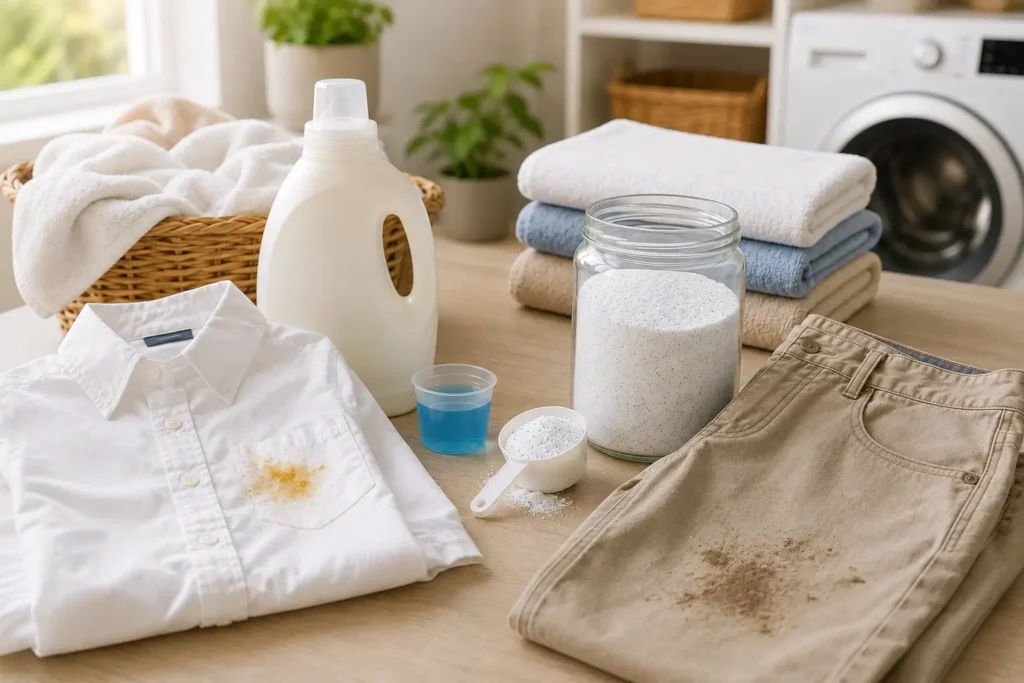
Liquid detergent is particularly convenient if you often deal with greasy or oily stains.
Because it is already liquid, many products can be applied directly to a stain before washing, as long as the detergent instructions and garment care label allow it.
That can be useful for stains such as:
- cooking oil
- makeup
- greasy food marks
- collar and cuff soil
Liquid detergent is also convenient for people who frequently wash in cool water because there are no powder granules that need to dissolve first.
That doesn’t mean liquid detergent always performs better in cold water. Modern detergents vary widely by formula. It simply removes one potential issue: undissolved powder.
When Powder Detergent Makes Sense
Powder detergent can be a good option for everyday loads and clothing with ground-in dirt.
It can be particularly useful for things like:
- muddy clothes
- dusty workwear
- children’s outdoor clothing
Powder can also be mixed with a little water to make a paste for pretreating certain stains, provided the product instructions allow it.
There are practical advantages too. It is easy to store, there is no liquid to leak, and some people simply prefer measuring from a box rather than pouring from a bottle.
What About Cold-Water Washing?
This is one of the more noticeable practical differences between the two formats.
Powder needs enough water and time to dissolve properly.
If you regularly use very cold water or short wash cycles, check whether your detergent is designed for those conditions.
Powder residue on clothing can sometimes be linked to poor dissolving or rinsing, particularly when the machine is overloaded or too much product is used.
Liquid detergent avoids the issue of granules needing to dissolve, but liquid can still leave residue when used incorrectly.
So if you prefer powder, cold-water washing doesn’t automatically mean you need to switch. Just make sure the product suits the way you wash.
Does One Clean Better?
Not necessarily.
There are situations where one format may be more convenient, but there is no simple rule that one format always cleans better than the other.
Liquid is handy for pretreating oily stains.
Powder is often a practical choice for ground-in dirt.
For an ordinary load of everyday clothing, either can work well.
The detergent formula, the amount you use, the wash cycle and the type of soil on the clothing can all affect the result.
If your current detergent consistently gets your clothes clean, there may be little reason to change simply because another format sounds better.
| Liquid | Powder | |
|---|---|---|
| Greasy stains | Often well suited | Can be used |
| Ground-in dirt | Good | Often useful |
| Cold water | Convenient | Check dissolving |
| Storage | Can leak | Easy to store |
| Pretreating | Very convenient | Can make paste |
Which One Is Cheaper?
There isn’t a universal winner here either.
Prices vary by brand, concentration, pack size and where you live.
Instead of comparing the price of the bottle or box, look at the cost per wash.
Check:
- how many washes the package claims to provide
- the recommended amount per load
- whether the detergent is concentrated
- the actual price per wash
A large bottle is not necessarily better value if you need a larger dose each time.
Likewise, a smaller concentrated detergent may last much longer than its package size suggests.
What About Packaging?
Powder and liquid also come with different packaging considerations.
Powder is often sold in cardboard boxes or lightweight bags, while liquid usually comes in bottles or refill pouches.
It can be tempting to say that one format is automatically the more environmentally friendly choice, but the full picture is more complicated.
Packaging material, detergent concentration, transportation, ingredients and how much product you use all matter.
If reducing packaging is important to you, compare the actual products available where you live rather than relying on the detergent format alone.
So Which Should You Choose?
Choose based on the laundry you actually do.
Liquid detergent may suit you if:
- you regularly pretreat greasy or oily stains
- you wash mostly in cool water
- you prefer a product that is already dissolved
- you find pouring liquid more convenient
Powder detergent may suit you if:
- you often wash muddy or dusty clothing
- you prefer a dry product
- you want something easy to store without leaks
- your usual wash cycles dissolve powder well
You also don’t have to commit to only one.
If there’s a practical reason for it, you can keep one detergent for most loads and another for particular stains or types of laundry.
Final Thoughts
There isn’t one best detergent format for every household.
Liquid detergent is convenient for greasy stains, pretreating and cool-water washing. Powder can be a practical choice for everyday laundry and ground-in dirt.
If the detergent you already use cleans your clothes well and works with your routine, you don’t need to switch simply because another format is marketed as better.
Choose the one that makes sense for the laundry you actually do.
Sources & Further Reading
American Cleaning Institute — Laundry Basics
General guidance on detergent formats, dosing and laundry use.
American Cleaning Institute — Stain Removal Guide
Information on using liquid detergent or a powdered detergent paste to pretreat different types of stains.
Maytag — White Residue on Clothing
Information about factors that can contribute to visible detergent residue, including excess detergent and very cold wash water.